 Pocket Botanist
Pflanzenratgeber
Round leaved sundew.
Drosera rotundifolia
Aussprache droh-SER-uh roh-tun-dih-FOH-lee-uh
Auch bekannt als Common Sundew, Round-leaf Sundew, Round-leaved Sundew, Roundleaf Sundew


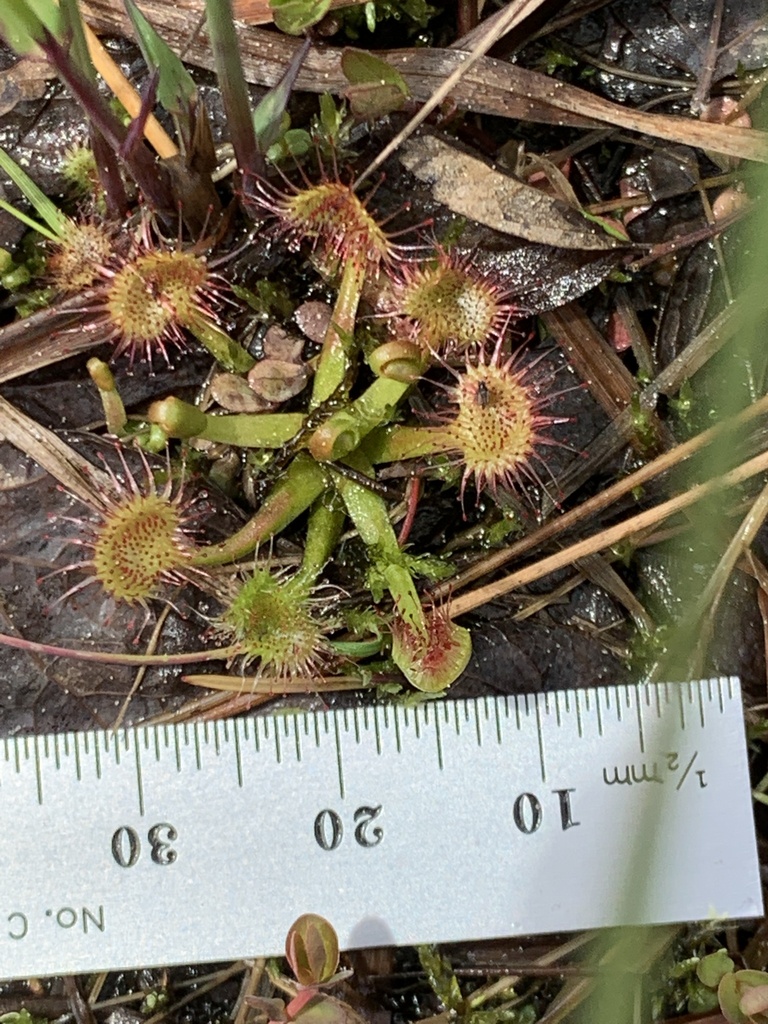
This fascinating carnivorous plant thrives in nutrient poor, boggy environments. It captures small insects using sticky, dew like droplets on its leaves. You will find it is a unique addition to a specialized collection.

Auf einen Blick
- Pflegestufe
- Schwierig
- Pflanzenart
- Carnivorous perennial
- Licht
- Full sun to partial shade
- Licht im Innenraum
- Direkte Sonne
- Gießen
- Alle 1 bis 2 Tage
- Endgröße
- 3 to 5 inches
- Wachstum
- Langsam
- Winterhärte
- USDA 3 bis 8
- Blütezeit
- Mid to late summer
Pflege
Keep the soil constantly moist by sitting the pot in a tray of distilled water. Avoid using tap water as minerals can harm the plant. Watch for dry, brown leaf tips which indicate the soil has lost its moisture.
- Gießen
- Always keep the soil saturated with distilled or rainwater.
- Düngen
- Do not fertilize this plant as it gets nutrients from insects.
- Schneiden
- Remove dead or blackened leaves to keep the plant tidy.
- Umtopfen
- Repot in fresh carnivorous plant soil mix every year or two.
- Boden
- Sphagnum peat moss and perlite mix
- Boden-pH
- 3.5 to 5.0
- Temperatur
- -20 bis 30°C
- Luftfeuchtigkeit
- 60 bis 100%
- Trockenheitstoleranz
- Gering
- Lebensdauer
- Perennial, typically 3 to 5 years.
- Wildverbiss-Resistenz
- Hoch
Anzeichen fürs Umtopfen
- The peat moss has broken down into a dense sludge.
- The plant has outgrown its current container.
- Mineral crusts have formed on the surface of the soil.
Sicherheit
- Menschen
- The plant is not considered toxic, but it is not edible.
- Kinder
- Keep this plant away from small children to prevent them from pulling off the sticky leaves or attempting to eat them.
- Kontaktallergene
- The sticky mucilage can cause mild skin irritation in sensitive individuals.
- Allergene in der Luft
- There are no known significant respiratory allergens associated with this plant.
- Essbarkeit
- This plant is not intended for consumption and contains compounds that may cause digestive distress.
So erkennst du die Pflanze
- Circular leaves with sticky tentacles
- Glistening dew drops on leaf surfaces
- Small white or pink flowers
- Low growing basal rosette habit
- Höhe
- 0,02 bis 0,05m
- Breite
- 0,05 bis 0,1m
- Blätter
- green, red, deciduous
- Blüten
- white, 0,5 bis 1cm
- Früchte
- black, Autumn
Häufige Probleme
- Aphids — Small insects that can colonize the leaves and disrupt the mucilage production.
Standort und Pflege
- Vermehrung
- seed, leaf cuttings
- Pflanzzeit
- spring
- Überwinterung
- The plant forms a dormant bud called a hibernaculum. Keep it in a cool, bright area and ensure the soil remains moist but not waterlogged during the winter months.
- Im Kübel
- It grows very well in pots, provided they are kept in a tray of water and use a minimum 10 cm diameter container.
Seed
- Sow seeds on the surface of damp peat moss.
- Maintain high humidity and bright light.
- Keep the soil consistently moist until germination.
Leaf Cuttings
- Carefully remove a healthy leaf.
- Place the leaf on wet sphagnum moss.
- Cover with a clear lid to maintain humidity until plantlets form.
Always plant in a bog-style container with a mix of peat moss and perlite to maintain the necessary acidity and moisture.
Gute Pflanzpartner
- Purple pitcher plant — They share similar requirements for high moisture and acidic, nutrient-poor soil.
- Sphagnum — It provides the ideal acidic, moisture-retentive substrate for sundews.
Ähnliche Arten
- Drosera filiformis — A related carnivorous plant with distinct, elongated leaves.
- Cape sundew — A common, easy-to-grow relative that is not cold-hardy.
Botanisches
- Familie
- Droseraceae
- Gattung
- Drosera
- Ordnung
- Caryophyllales
- Klasse
- Magnoliopsida
- Ursprüngliche Heimat
- Circumboreal distribution across North America, Europe, and Asia.
- Artenschutz
- It is protected in some regions due to habitat loss and should never be collected from the wild.
It survives in waterlogged, acidic, and nutrient-poor peat bogs by trapping insects to obtain nitrogen.
- Nutzen für Wildtiere
- nectar source
- Bestäuber
- Bienen, Schmetterlinge, Käfer
- Verwendung
- bog garden specimen, educational plant
Im Jahresverlauf
Ökologische Zeigerwerte
- Salzgehalt
- 1/9
- Bodenreaktion
- 2/9
- Licht
- 8/9
- Temperatur
- 3/9
- Feuchtigkeit
- 9/9
- Nährstoffe
- 1/9
Taxonomie abgeglichen mit GBIF.
Häufige Fragen
- Does it need tap water?
- No, always use distilled, rain, or reverse osmosis water to avoid mineral buildup.
- Should I feed it bugs?
- It will catch its own food if kept outdoors, but you do not need to feed it manually.
Woher der Name kommt
The genus name Drosera comes from the Greek word for dew, referring to the glistening droplets on the leaves, while rotundifolia describes the round shape of the leaves.
Gut zu wissen
- It is also known as the round-leaved sundew.
- The plant thrives in nutrient-poor, acidic bogs.
- It forms a winter resting bud called a hibernaculum to survive cold temperatures.
- The leaves are arranged in a basal rosette close to the ground.
Auch in
Probleme mit Round leaved sundew?
Diese Seite bietet allgemeine Infos. Pocket Botanist erkennt Probleme anhand eines Fotos deiner echten Pflanze, passt das Gießen an dein Licht und deinen Standort an und erinnert dich an die Pflege.
Dieser Ratgeber wurde mit KI erstellt und mit der GBIF-Taxonomie abgeglichen. Er dient zur allgemeinen Information und ersetzt keine gärtnerische oder tierärztliche Beratung. Hier erfährst du, wie wir diese Ratgeber erstellen.